


Obagi Medical Skin Care System in Bakersfield: What It Is and Why Providers Recommend It
Obagi Medical is a physician-dispensed skincare system clinically proven to correct hyperpigmentation, sun damage, and uneven tone. Learn how Beautologie in Bakersfield uses Obagi to deliver real, supervised skin transformation.
Obagi Medical Skin Care System in Bakersfield: What It Is and Why Providers Recommend It
Not all medical-grade skincare is created equal. If you've spent years searching for a product line that actually delivers on its promises for hyperpigmentation, fine lines, and uneven tone — Obagi Medical may be what you've been missing. At Beautologie Cosmetic Surgery & Medical Aesthetics in Bakersfield, we carry the Obagi Medical system and incorporate it into customized skincare protocols for our patients.
Here's an in-depth look at the Obagi system, how it works, and who benefits most from it.
What Is Obagi Medical?
Obagi Medical is a physician-dispensed skincare brand founded in 1988 by dermatologist Dr. Zein Obagi. The brand's core philosophy: surface-level moisturizers and over-the-counter brighteners can't create lasting change in skin that has been damaged by sun exposure, age, or acne scarring. True transformation requires active ingredients that penetrate into the deeper layers of the skin.
The Obagi system is built around clinically studied actives — primarily hydroquinone, tretinoin, and alpha-hydroxy acids — at concentrations and formulations that require medical supervision and a prescription for the highest-strength versions.
The Nu-Derm System: The Foundation of Obagi
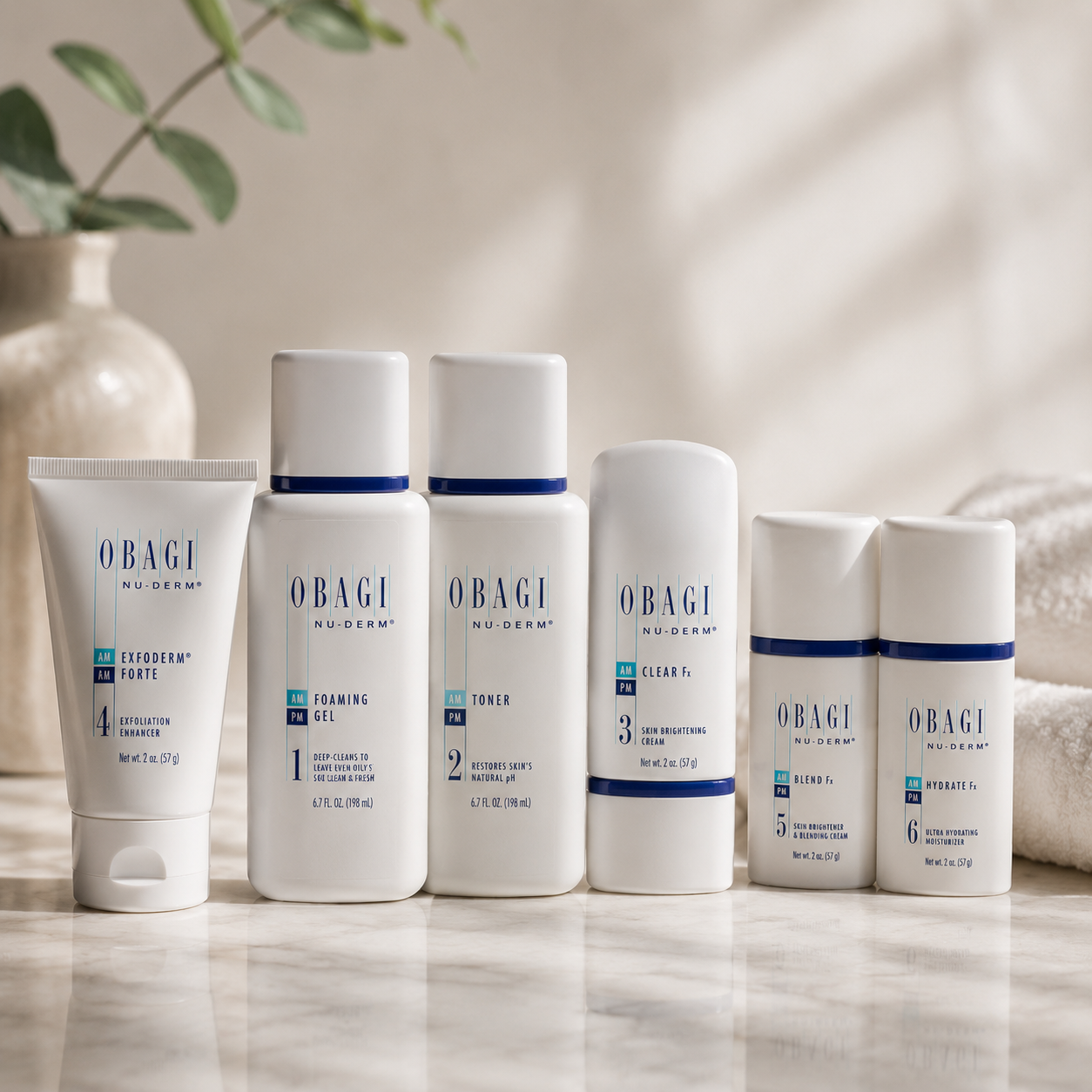
The flagship product line is the Obagi Nu-Derm System, a comprehensive prescription-strength regimen designed to correct sun damage, hyperpigmentation, age spots, melasma, and uneven skin tone. The full system typically includes:
- Foaming Gel or Gentle Cleanser — prepares the skin and removes surface buildup
- Toner — balances pH and supports product penetration
- Clear (Hydroquinone 4%) — lightens existing hyperpigmentation by inhibiting melanin production
- Exfoderm or Exfoderm Forte — promotes cell turnover with PHA or AHA
- Blender (Hydroquinone 4%) — used in combination with tretinoin to prevent post-inflammatory darkening
- Sunscreen (SPF 30+) — protects corrected skin during the day
- Tretinoin (Prescription) — accelerates cellular renewal and boosts collagen synthesis
The system is used in a specific order, twice daily, and is supervised by a medical provider. Early stages of the protocol may involve a period of skin "transformation" — temporary redness, flaking, or sensitivity — as the skin turns over and rebuilds. This is normal and expected; providers call it the "purging" phase, and it typically resolves within 4–8 weeks.
What Conditions Does Obagi Treat?
The Obagi Nu-Derm System is clinically studied for:
- Melasma — hormonal or UV-triggered pigmentation common after pregnancy or with oral contraceptive use
- Sun damage and age spots — accumulated UV damage that creates uneven discoloration
- Post-inflammatory hyperpigmentation (PIH) — darkening after acne breakouts or skin injury
- Uneven skin tone and dullness — generalized lack of radiance and clarity
- Fine lines and early wrinkling — addressed through tretinoin's collagen-stimulating mechanism
It is not a treatment for moderate-to-severe dynamic wrinkles or significant skin laxity — for those concerns, the Obagi system works best as part of a combined protocol that includes energy devices, injectables, or surgical intervention.
Why Medical-Grade Matters
Over-the-counter brightening products typically contain lower concentrations of active ingredients and lack the tretinoin component that drives cellular renewal. According to the American Academy of Dermatology, tretinoin (topical retinoid) is one of the few ingredients with a substantial body of peer-reviewed evidence for reducing fine lines, improving skin texture, and treating hyperpigmentation.¹
Hydroquinone remains the gold standard for melanin suppression and is the most effective topical agent for hyperpigmentation correction when used as directed under medical supervision.²
What to Expect From the Obagi System
Timeline:
- Weeks 1–4: Skin may appear dry, flaky, or irritated — this is the transformation phase
- Weeks 4–8: Redness and sensitivity improve; skin begins to look clearer and more even
- Weeks 8–16: Significant reduction in pigmentation, smoother texture, more uniform tone
- 6+ months: Ongoing improvement with sustained use; skin maintenance phase begins
How long should you stay on it?
Your Beautologie provider will supervise your progress and adjust your protocol as needed. Most patients complete a 6-month correction course and then transition to a maintenance regimen that includes tretinoin, SPF, and select Obagi products.
Combining Obagi With Other Treatments
Obagi works synergistically with many in-office treatments we offer at Beautologie. Common combinations include:
- Obagi + Morpheus8 — skin prep before fractional RF improves results; maintenance protocol extends them
- Obagi + Chemical Peels — peels deepen exfoliation and accelerate pigment correction
- Obagi + PDO Threads — addresses both surface quality and structural laxity together
- Obagi + Injectables — addresses color and texture while Botox/fillers address volume and movement
Obagi at Beautologie in Bakersfield
We prescribe and supervise Obagi treatment plans for patients in Bakersfield and throughout Kern County. Our providers assess your skin type, concerns, and history before recommending the right regimen — whether that's the full Nu-Derm system, the Obagi-C Rx for maintenance, or a targeted approach using specific active products.
Start Your Obagi Skin Consultation
If you've struggled to see results from over-the-counter skincare, it may be time to step up to a medically supervised protocol. Book a skincare consultation at Beautologie to find out if the Obagi system is right for you.
Book Your Skincare Consultation at Beautologie →
References:
- American Academy of Dermatology. Retinoids for Skin. https://www.aad.org
- American Academy of Dermatology. Hyperpigmentation: Diagnosis and Treatment. https://www.aad.org
Marketing Director, Beautologie


All information, images, articles and text on this website are copyrighted by Beautologie Medical Group Inc. and cannot be downloaded, copied, redistributed or used in any way without written permission.
*Individual results may vary.
Beautologie strives to ensure that its services are accessible to people with disabilities. Beautologie.com has invested a significant amount of resources to help ensure that its website is made easier to use and more accessible for people with disabilities, to provide educational resources to all. If you are experiencing difficulty with any content on Beautologie.com or require assistance with any part of our site, please contact us during normal business hours as detailed above and we will be happy to assist. If you wish to report an accessibility issue, have any questions or need assistance, please contact beautologie.com Customer Support at info@beautologie.com