


What Are Adjustable Saline Implants? A Full Guide

What Are Adjustable Saline Implants? A Full Guide
Choosing breast augmentation is a deeply personal decision, and a huge part of that process is selecting your implants. If you're weighing your options, you've likely compared the saline vs. silicone implants look and visualized them side by side. The great news? Modern technology gives you incredible choices. From silicone that beautifully mimics natural tissue to innovative adjustable saline implants that allow for fine-tuning after surgery, you can achieve truly personalized results. This guide will help you understand the key differences so you can make a confident and informed decision for your body.
But one question almost every patient asks during a consultation is:
“Should I choose saline or silicone implants?”
At Beautologie, our board-certified plastic surgeons have performed thousands of breast augmentation procedures across Bakersfield and Stockton, and beyond. We understand that choosing an implant is not just a clinical decision—it’s an emotional one tied to body image, comfort, confidence, and long-term satisfaction.
This comprehensive guide breaks down the differences between saline and silicone implants clearly, compassionately, and accurately, so you can make an informed choice with complete confidence.
Key Takeaways
- Saline implants offer smaller incisions, adjustability, and visible rupture detection.
- Silicone implants provide the softest, most natural feel and less rippling.
- Implant choice depends on anatomy, breast tissue amount, aesthetic goals, and surgeon guidance.
- Silicone is the most popular option today due to its natural look and feel.
- A consultation is essential to determine ideal implant size, placement, and type.
Saline vs. Silicone: What's the Difference?
Breast implants come in many sizes, projections, and profiles—but the fill material inside the implant plays one of the biggest roles in how your breasts look and feel after surgery.
Today, the two choices are:
- Saline implants
- Silicone implants
Both have silicone outer shells, but their internal composition—and how they behave in the body—is different.
Key Physical Differences
Think of saline implants as a durable silicone shell that’s filled with a sterile saltwater solution after it’s been placed in the breast pocket. This technique allows for a smaller incision, which can mean a less noticeable scar. If a saline implant were to leak, the saltwater is safely absorbed by your body, and the implant deflates. While this sounds dramatic, it makes ruptures immediately obvious, which many women in Bakersfield find reassuring. There’s no guesswork involved; you know right away and can schedule a follow-up to have it addressed.
Silicone implants, on the other hand, come pre-filled with a soft, cohesive silicone gel. This gel has a texture that feels remarkably similar to natural breast tissue, which is why it’s the most popular choice today. Because of their consistency, silicone implants are also less likely to show visible rippling under the skin, creating a very smooth and natural contour. It's important to know that if a silicone implant ruptures, it may not be immediately apparent—this is often called a "silent rupture." For this reason, the FDA recommends routine monitoring to check on the implants and ensure they are intact. Ultimately, the best way to decide is by discussing your specific anatomy and aesthetic goals during your breast augmentation consultation.
Exploring Saline & Adjustable Saline Implants
Saline implants are filled with sterile saltwater solution once placed in the breast pocket. This allows for certain advantages in placement and adjustability.
The Pros of Choosing Saline Implants
1. Smaller Incisions
Because saline implants are inserted empty and filled afterward, the incision can be slightly smaller than what is needed for pre-filled silicone implants.
2. Adjustable During Surgery
Your surgeon can add or remove a small amount of saline to fine-tune breast symmetry or volume during the procedure.
3. Easy Rupture Detection
If the implant breaks, the body safely absorbs the saline and breast volume decreases visibly—meaning no imaging is required to confirm rupture.
4. Generally Lower Upfront Cost
Saline implants are typically more affordable, making them appealing for some patients.
What to Consider with Saline Implants
1. Firmer Feel
Saline implants tend to feel less like natural breast tissue and may feel slightly firmer to the touch.
2. Increased Rippling Risk
Because saline is a liquid, the implant shell can ripple more, particularly in patients with thin breast tissue or low body fat.
3. Less Natural Movement
Silicone implants often mimic natural tissue movement better than saline.
The Special Case: Post-Surgery Adjustable Implants
A unique subset of saline implants are post-surgery adjustable implants, designed for patients who want the ultimate flexibility in fine-tuning their results after their initial procedure. These implants contain a small, discreet port that allows a surgeon to add or remove sterile saline solution in the weeks or months following surgery. This process is done in-office and lets you make small changes until you are completely happy with the size and symmetry, potentially avoiding the need for a second revision surgery. This option is particularly helpful for correcting asymmetry or for women who are uncertain about their final desired volume. The FDA recognizes these devices as a specialized choice your surgeon can discuss during your consultation to see if they fit your goals.
How Long Do Saline Implants Last?
One of the most common questions we hear is about implant lifespan. While you may have heard the old "10-year rule," modern saline implants are much more durable. According to the American Society of Plastic Surgeons, there is no exact expiration date, and today's implants can last 10 to 20 years or even longer. However, it's important to remember they are not considered lifetime devices. The biggest factor is the implant shell itself, which can weaken over time. If a saline implant does rupture, the process is straightforward: the shell leaks, the breast deflates, and your body safely absorbs the sterile saltwater. This makes ruptures easy to detect without special imaging. Regular check-ins with your surgeon are the best way to monitor your breast augmentation results and ensure your implants remain in good condition.
Are Saline Implants Right for You?
- Patients with enough natural breast tissue to cover the implant
- Individuals who want smaller incisions
- Those who prefer visible rupture detection
- Patients on a more conservative budget
A Closer Look at Silicone Gel Implants
Silicone implants are filled with a cohesive silicone gel designed to closely mimic the softness, weight, and feel of natural breast tissue.
The Pros of Choosing Silicone Implants
1. Most Natural Look and Feel
Silicone gel is soft and cohesive, allowing the implant to move more like natural breast tissue.
2. Less Rippling
Because silicone gel holds its shape better than saline, rippling is significantly reduced—making it a top choice for thin or athletic patients.
3. High Patient Satisfaction
Most women who undergo breast augmentation choose silicone implants due to their realism and longevity.
4. Broad Range of Profiles and Shapes
Silicone implants allow for precise customization of projection, width, and fullness.
What to Consider with Silicone Implants
1. Requires Imaging for Silent Rupture
Silicone implant ruptures are rare, but when they occur, they’re often not visible. MRI or high-resolution ultrasound helps confirm implant integrity.
2. Slightly Larger Incision
Because implants come pre-filled, incisions are usually a bit longer than for saline implants.
Understanding Silicone Implant Longevity
A common myth is that silicone implants have a strict 10-year expiration date. While they are not considered lifetime devices, the reality is that modern implants are incredibly durable. Many of today's advanced silicone gel implants can last 15 to 20 years or even longer without any problems. Instead of focusing on a fixed timeline, replacement is typically recommended only if you experience a complication, such as a rupture, or if you decide you want to change the size or style of your implants for personal reasons.
Because silicone ruptures can be "silent," the FDA recommends periodic monitoring with an MRI or high-resolution ultrasound to check on your implants. This isn't something to be anxious about; it's simply a proactive way to ensure your long-term health and satisfaction. Your surgeon will provide a personalized screening schedule and partner with you over the years to monitor your results, ensuring your peace of mind and the longevity of your beautiful outcome.
Are Silicone Implants Right for You?
- Patients wanting the most natural feel
- Individuals with minimal breast tissue
- Those concerned about rippling
- Women seeking a soft, balanced, proportionate look
Surgical Technique: Placement and Support
Choosing between saline and silicone is a huge step, but it’s only one piece of the puzzle. The surgical technique your doctor uses—specifically where the implant is placed—is just as critical for achieving the beautiful, natural-looking results you want. The best implant in the world won’t look right if it’s not placed correctly for your body type. This is where the artistry and experience of a board-certified plastic surgeon truly shine. During your consultation, we don’t just talk about implants; we create a complete surgical plan tailored to your anatomy and aesthetic goals.
Under the Muscle vs. Over the Muscle Placement
One of the most important decisions you and your surgeon will make is whether to place the implant under or over the pectoral muscle. According to the American Society of Plastic Surgeons, submuscular (under the muscle) placement is often preferred because the muscle provides an extra layer of tissue to cover the implant. This helps create a smooth, natural slope and significantly reduces the visibility of implant edges or rippling, especially in women with less natural breast tissue. Over the muscle placement, or subglandular, can also be an option, but the best choice depends entirely on your body, your tissue, and your desired outcome. Our surgeons at Beautologie will carefully evaluate your anatomy to recommend the placement that will give you the most stunning and lasting results for your breast augmentation.
Implants for Breast Reconstruction
While most of our patients at Beautologie are seeking cosmetic enhancement, it’s worth noting the incredible versatility of implant technology, especially in breast reconstruction. For patients who have undergone a mastectomy, adjustable saline implants play a vital role. These devices are placed and then gradually filled with saline over several weeks or months. This process, as detailed in research from StatPearls, allows the skin and surrounding tissue to gently stretch and expand, creating a new breast mound. This technique gives surgeons precise control over the final size and shape, helping to restore symmetry and form in a way that is both safe and effective. It’s a powerful example of how implant technology can be adapted for different, life-changing purposes.
Saline vs. Silicone: Which Implant Looks More Natural?
If your primary goal is the most natural appearance and feel, silicone implants are traditionally the top choice among both patients and surgeons. The cohesive gel inside silicone implants mimics natural breast density, movement, and softness exceptionally well.
Saline can also look natural in patients who already have substantial breast tissue to cover the implant shell. However, for petite, slender, or athletic patients, silicone typically produces more seamless, elegant results.
Silicone vs. Saline: A Side-by-Side Comparison
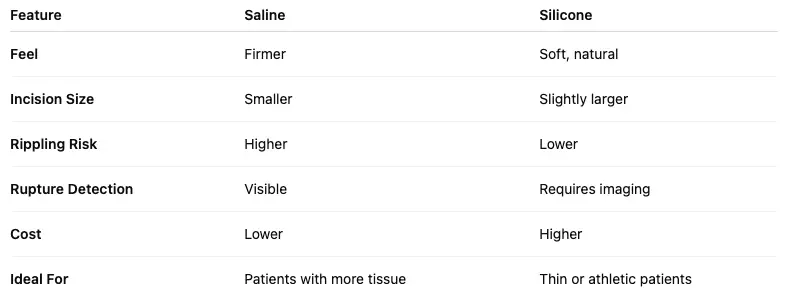
How Your Surgeon Helps You Choose the Right Implant
Choosing between saline and silicone isn't something you need to figure out alone. During your consultation at Beautologie, your surgeon evaluates:
1. Your Anatomy
This includes chest width, breast tissue amount, skin elasticity, rib cage shape, and nipple position.
2. Your Desired Look
Do you want subtle enhancement? Rounder cleavage? An athletic contour? Photos and sizing tools help clarify your goals.
3. How the Implant Will Age on Your Body
Silicone maintains its shape and feel longer, while saline may gradually show more rippling over time.
4. Your Lifestyle and Fitness Level
Athletes, bodybuilders, and postpartum patients often benefit from specific implant types for stability and movement.
5. Your Long-Term Plans
If you plan on future pregnancies, weight changes, or additional cosmetic procedures, your surgeon may recommend the implant that will provide the longest-lasting, most predictable outcome.
Who Isn't a Good Candidate for Breast Implants?
While breast augmentation can be a life-changing procedure for many women, it's not the right fit for everyone. Your safety and long-term health are always the top priorities, and a responsible surgeon will only proceed if you are a healthy, well-informed candidate. During your consultation, we'll discuss your full medical history to ensure surgery is a safe and effective option for you. Certain factors can increase surgical risks or compromise your results, making it important to be transparent with your surgeon about your health and lifestyle.
For example, smoking significantly complicates healing and increases the risk of postoperative issues. The American Society of Plastic Surgeons strongly advises quitting well in advance of any elective surgery. Similarly, individuals with active infections, certain autoimmune conditions like scleroderma, or a history of radiation therapy to the breast may not be ideal candidates due to potential complications with healing and implant integration. It's also important to wait until after you have finished breastfeeding to consider breast surgery.
Beyond physical health, a good candidate has realistic expectations about what breast augmentation can achieve. The goal is improvement, not perfection, and feeling confident in your own skin. If you have any of these conditions or are unsure about your eligibility, the best step is an honest conversation with a board-certified plastic surgeon. They can provide a personalized assessment and determine the safest path forward for your aesthetic goals here in Bakersfield.
Are Silicone Implants Safe?
Yes. Modern silicone implants are FDA-approved, cohesive, and rigorously tested. Extensive studies have shown no increased risk of breast cancer or autoimmune disease.
Your surgeon will discuss:
- The importance of routine imaging
- What a silent rupture is
- How to monitor implants long-term
The overwhelming consensus among aesthetic and reconstructive surgeons is that silicone implants are safe when placed properly and monitored appropriately.
FDA Screening Guidelines for Silicone Implants
Because the cohesive gel in silicone implants holds its shape so well, a rupture isn't always immediately obvious—this is often called a "silent rupture." To ensure your long-term health and peace of mind, routine monitoring is a standard part of having silicone implants. The U.S. Food and Drug Administration (FDA) suggests getting your first imaging scan (either an MRI or a high-resolution ultrasound) about 5 to 6 years after your initial surgery. After that, a follow-up scan every 2 to 3 years is recommended. This proactive screening helps confirm your implants are intact and allows you to enjoy your beautiful results with confidence for many years.
A Note on BIA-ALCL
It's important to have a transparent conversation about all aspects of breast implants, including the rare condition known as Breast Implant-Associated Anaplastic Large Cell Lymphoma (BIA-ALCL). This is not breast cancer, but a very uncommon and typically treatable cancer of the immune system that can form in the scar tissue capsule around an implant. According to the American Society of Plastic Surgeons (ASPS), the risk is low and has been more significantly linked to textured-surface implants rather than the smooth implants that are most commonly used today. Knowing the signs, such as persistent swelling or pain around the implant, is key for early detection.
Patient safety is the cornerstone of our practice at Beautologie. During your private consultation, our board-certified plastic surgeons will thoroughly review the latest safety data and answer all of your questions about implant types and long-term monitoring. We believe that an educated patient is an empowered patient, and we are committed to providing the guidance you need to make a choice that feels right for you, ensuring you feel secure and supported every step of the way.
Understanding the Risks of Breast Augmentation
All surgeries involve risk, although complications are uncommon with experienced, board-certified plastic surgeons. Possible issues include:
- Capsular contracture
- Infection
- Rippling
- Implant rupture
- Temporary sensation changes
- Asymmetry
- Need for revision surgery
Beautologie minimizes risk through:
- AAAHC-accredited surgery centers
- Thousands of successful breast procedures
- Advanced surgical techniques
- Rigorous sterility and patient safety protocols
Results vary individually, and a private consultation is essential to determine candidacy and surgical planning.
Explaining Capsular Contracture
One of the most discussed risks is capsular contracture. When an implant is placed in the body, your natural healing response forms a soft scar tissue "capsule" around it. This is normal. However, sometimes this capsule can become unusually hard and tight, squeezing the implant. According to research, this is known as capsular contracture, and it can cause the breast to feel firm, look distorted, or become painful. While it's the most common reason for reoperation, choosing an experienced surgeon who uses meticulous techniques can significantly lower your risk. During your consultation, your surgeon will explain how they work to prevent this and what the treatment options are if it occurs.
Other Potential Complications to Know
While serious issues are rare, it’s important to be aware of other potential complications. These can include infection, fluid collection (seroma), bleeding (hematoma), or changes in nipple sensation. Another possibility is "animation deformity," where the implant moves with the contraction of your chest muscle. A board-certified plastic surgeon will discuss your personal risk factors and the steps taken to ensure a safe procedure and smooth recovery. Following all pre- and post-operative instructions is key to minimizing these risks and achieving a beautiful, lasting outcome you can feel confident about.
Long-Term Planning: Revisions and Follow-Up Care
It’s important to think of breast implants as long-lasting, but not necessarily lifetime, devices. Over the years, your body, aesthetic preferences, and the implants themselves can change. The American Society of Plastic Surgeons notes that many women may need or want a revision surgery at some point. This isn't a sign of failure, but rather a normal part of the long-term journey. Reasons for a future procedure can vary widely. It might be to address an issue like capsular contracture or an implant rupture, but often, it’s simply because a patient desires a different size or shape as her style and body evolve over time.
This is why follow-up care is so important. Regular check-ins with your surgeon and routine imaging (for silicone implants) help monitor the health and integrity of your implants. At Beautologie, we view our relationship with patients as a long-term partnership. We are here to support you not just through your initial breast augmentation, but for years to come, helping you maintain your results and make any adjustments needed to ensure you continue to love your look. Planning for the future means you can enjoy your results with peace of mind, knowing you have a clear path for any changes you may want down the road.
Your Options for Revision Surgery
If you decide it's time for a change, you have several great options. The most common approach is an implant replacement, where the old implants are swapped for new ones. This is a perfect opportunity to change your implant size, type (perhaps switching from saline to silicone), or profile. Another option is an implant removal, or "explant" surgery. Some women decide they no longer want implants and choose to have them taken out. This procedure can often be combined with a breast lift to reshape the natural breast tissue and address any skin laxity for a beautiful, implant-free contour.
Lifestyle Factors and Protecting Your Results
Your daily habits play a big role in the longevity of your breast augmentation results. Maintaining a stable weight is important, as significant weight fluctuations can stretch the skin and alter the shape of your breasts. Protecting your investment also means wearing supportive bras, especially during exercise or high-impact activities, to prevent unnecessary strain on the breast tissue and implant pocket. Finally, don't forget about your skin. Protecting the delicate skin on your chest from sun damage will help maintain its elasticity and quality over time. Using high-quality professional skincare products can keep your skin healthy and vibrant, beautifully complementing your surgical results.
The Importance of Post-Operative Care
Your beautiful result is a team effort, and your role in recovery is crucial. Following your surgeon’s post-operative instructions to the letter is the single best thing you can do to ensure a smooth healing process. This includes everything from caring for your incisions and managing drains to wearing your surgical bra and avoiding strenuous activity for the recommended period. It’s also vital to stop smoking, as it can severely impair your body's ability to heal. At Beautologie, we provide you with comprehensive guidance and are always here to answer your questions, ensuring you feel supported and confident every step of the way through your recovery.
Your Breast Augmentation in Bakersfield & Stockton
If you’re considering breast augmentation in Bakersfield or Stockton, Beautologie is recognized as one of California’s leading destinations for breast implant surgery. Our board-certified, fellowship-trained surgeons specialize in both saline and silicone implants, providing personalized recommendations based on your anatomy and aesthetic goals. Patients across the Central Valley trust Beautologie for natural-looking results, exceptional safety standards, and an unmatched patient experience from consultation to recovery.
Frequently Asked Questions
1. Which implant feels more natural: saline or silicone?
Silicone implants feel softer and more similar to natural breast tissue, making them the most popular option.
2. Are saline implants still a good choice?
Yes. They’re affordable, adjustable, and allow smaller incisions—especially for patients with adequate tissue coverage.
3. Do silicone implants increase cancer risk?
No. FDA studies show no link between silicone implants and breast cancer.
4. How long do breast implants last?
While implants are not lifetime devices, many last 10–20+ years before elective replacement.
5. Will saline implants ripple more?
In thinner patients, yes. Silicone tends to ripple less due to its cohesive gel interior.
6. What happens if a silicone implant ruptures?
Ruptures are usually silent and detected through imaging, but the cohesive gel typically stays within the implant shell.
7. Can implants look natural and not overly round?
Absolutely. With the right implant, size, and placement, results can look beautifully natural and proportionate.
8. Do I need a breast lift instead of implants?
If sagging is present, a lift may be recommended in addition to implants for the best result.
9. Are saline or silicone implants better for postpartum patients?
Most postpartum patients choose silicone for softness and reduced rippling.
10. Which option works best for athletic women or bodybuilders?
Silicone implants generally provide the most stability and realism.
11. Does implant placement (above vs. below the muscle) affect feel?
Yes. Placement influences movement, softness, and long-term appearance—your surgeon will evaluate what’s best for you.
12. Can I switch from saline to silicone later?
Yes. Many patients upgrade to silicone during a revision surgery for improved softness and shape.
Ready to Discuss Your Options? Schedule Your Complimentary Consultation
Ready to explore which implant type is right for your body and your goals?
At Beautologie, our board-certified, award-winning surgeons have helped thousands of women achieve beautifully personalized, natural-looking breast augmentation results. From saline to silicone, size to profile, and placement to recovery, we tailor every detail with artistry, precision, and compassion.
✨ Schedule a complimentary consultation at our Bakersfield or Stockton locations and discover your perfect implant choice with California’s leading cosmetic surgery team. Call (844) 232-8865
Your confidence. Your body. Your transformation.
Beautologie is here to guide you—every step of the way.
Related Articles
- Saline Breast Implants Remain a Favorite in Bakersfield | Beautologie
- Breast Implants: Saline vs. Silicone | Beautologie Bakersfield & Stockton | Beautologie
- What Are the Different Options for Breast Implants? | Beautologie
- Breastfeeding After Breast Implants: What You Need to Know | Beautologie
- Choosing the Right Breast Implant: MemoryGel® vs. BOOST™ | Beautologie
Marketing Director, Beautologie


All information, images, articles and text on this website are copyrighted by Beautologie Medical Group Inc. and cannot be downloaded, copied, redistributed or used in any way without written permission.
*Individual results may vary.
Beautologie strives to ensure that its services are accessible to people with disabilities. Beautologie.com has invested a significant amount of resources to help ensure that its website is made easier to use and more accessible for people with disabilities, to provide educational resources to all. If you are experiencing difficulty with any content on Beautologie.com or require assistance with any part of our site, please contact us during normal business hours as detailed above and we will be happy to assist. If you wish to report an accessibility issue, have any questions or need assistance, please contact beautologie.com Customer Support at info@beautologie.com